
Choosing a secondary school is an important step in your child's education in England, and it calls for careful planning and informed decisions. This guide aims to help you understand the secondary school application process and choose the school that's right for your child.
Moving to Secondary School
In England, children start secondary school at 11, after finishing Year 6. Secondary school applications open in September of the year your child starts Year 6 and must be completed by 31 October.
Criteria for Choosing a School
To assess schools' performance, just as with primary schools, we can look at their academic results on the Compare School Performance website.
When you open a school's page on the site, you'll usually see the following four main headings:
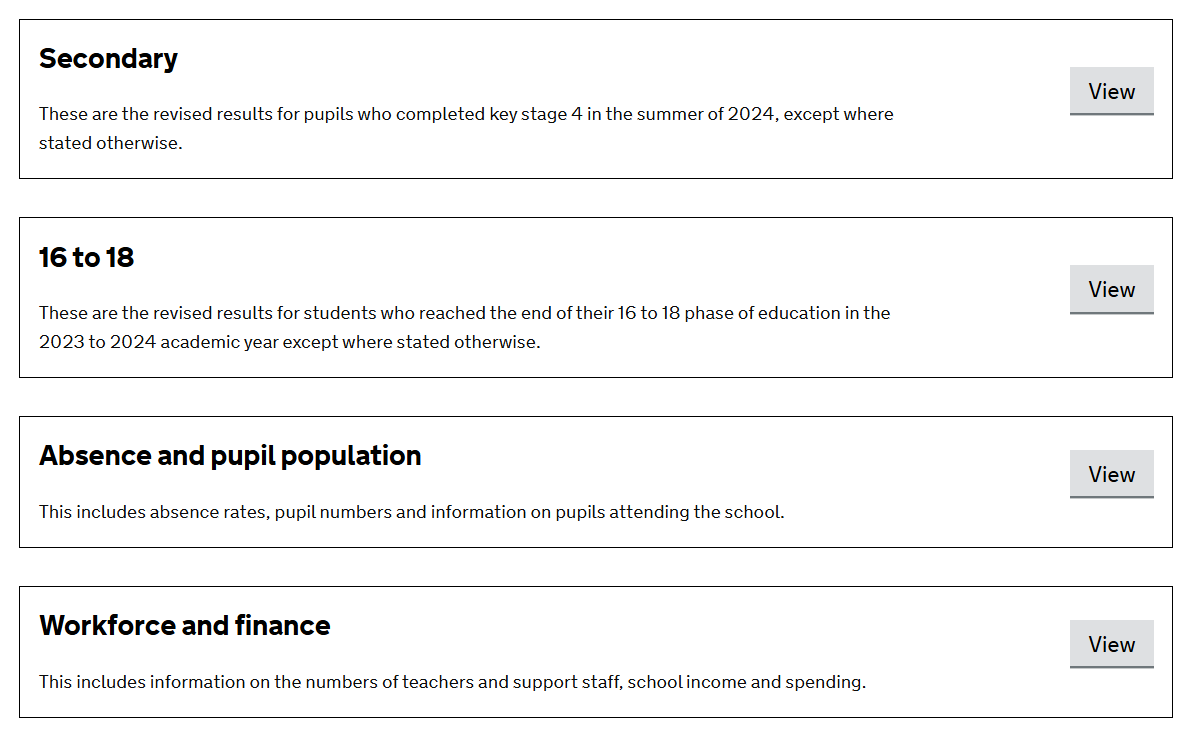
16-18 section only appears for schools that have a Sixth Form . If the school doesn't have a Sixth Form, this section isn't shown. I'll explain what's in it in a post about choosing a sixth form.
"Absence and population" and "Workforce and finance" sections are the same as for primary schools, so I recommend looking there.
In this post we'll focus on the “Secondary" section.
When you open the “Secondary” section, you'll first see some charts and reports. These are:
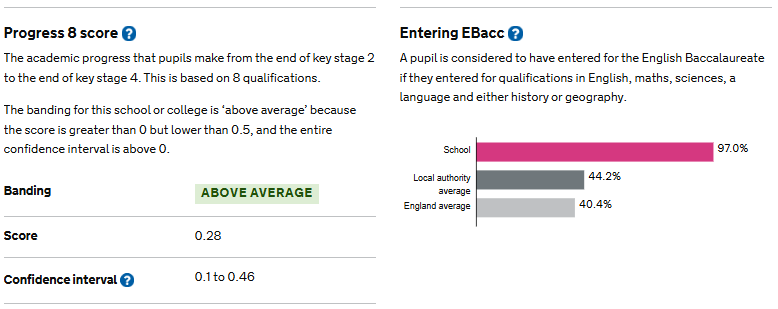
1.Progress 8 Score:
This score shows how much progress students at this school made between the end of Key Stage 2 (SATs) and the end of Key Stage 4 (GCSEs), compared with students across England who had similar results at Key Stage 2. It's based on results in up to 8 subjects in total: 3 English Baccalaureate subjects, such as English, maths, science, computer science, history, geography and languages, plus 3 other subjects.
In short, it gives you a report on how far the school takes a student from where they were in Year 7 to the end of Year 11, compared with all students nationally.
We can see that the school in this example is above average in this category.
2. Entering EBacc
Before looking at this report, it's important to understand the EBacc(English Baccalaureate).
EBaccis a measure based on students taking GCSE exams, and achieving well, in the following five main subject groups:
- English
- Maths
- Science (including combinations such as physics, chemistry, biology or combined science)
- A foreign language (e.g. French, German, Spanish, Latin, etc.)
- History or Geography (students only need to choose one of these two)
What is the aim?
The aim of the EBacc is to encourage students to choose academically strong subjects that can be an advantage when moving on to university. The government wants more students to study these subjects because they:
- are seen as a foundation for future study and job opportunities,
- are among the subjects universities generally prefer.
In this example, 97% of students at the school entered GCSEs in each of the subjects above and achieved well.
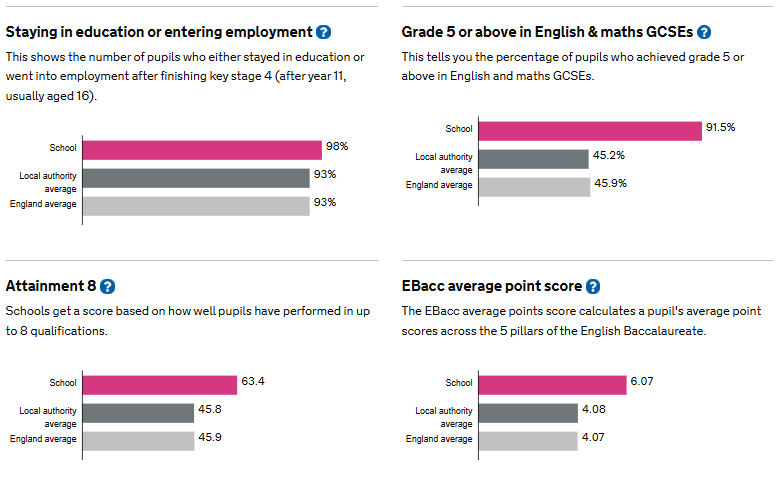
3. Staying in education or entering employment
This section shows what percentage of students stay in education or go into employment after Year 11.
4. Grade 5 or above in English & maths GCSEs
This table shows what percentage of students achieved GCSE English and maths at a pass grade of 5 or above .
While you need at least a 5 in these two subjects to go on to sixth form and university, it's striking that the national average is 45.9% .
If the school you're looking at is also below your local authority's average in this report, it may be worth thinking again and, if necessary, considering a different school .
5. Attainment 8
This score is calculated from students' results in up to 8 subjects. These include 3 English Baccalaureate (EBacc) subjects, such as English, maths, science, computer science, history, geography and languages, plus 3 other approved subjects.
6. EBacc average point score
The EBacc Average Point Scorecalculates a student's average score across the 5 pillars of the English Baccalaureate. It's calculated by scoring the student's best grades and dividing the total by 6 to get an average (because science counts as 2 separate pillars, making 6 in total).
This measure creates an average across subjects (i.e. the total is divided by 6). In this respect it uses a different scale from Attainment 8 , which scores up to 8 subjects without dividing the total.
This measure is based on:
- If the student took both English language and English literature, the higher of the two,
- Maths,
- the best 2 results from the single sciences (at least 3 of the 4 must be taken), or the combined science result,
- the better result from geography or history,
- the best result from foreign languages.
When looking at these reports, you can compare the school's results with both your local authority average and the national average . But comparing a single school only against averages can be misleading. So I recommend choosing at least 3 different schools and comparing them.
Once you've compared schools using these reports, I'd also like to briefly mention the other headings further down the same page.
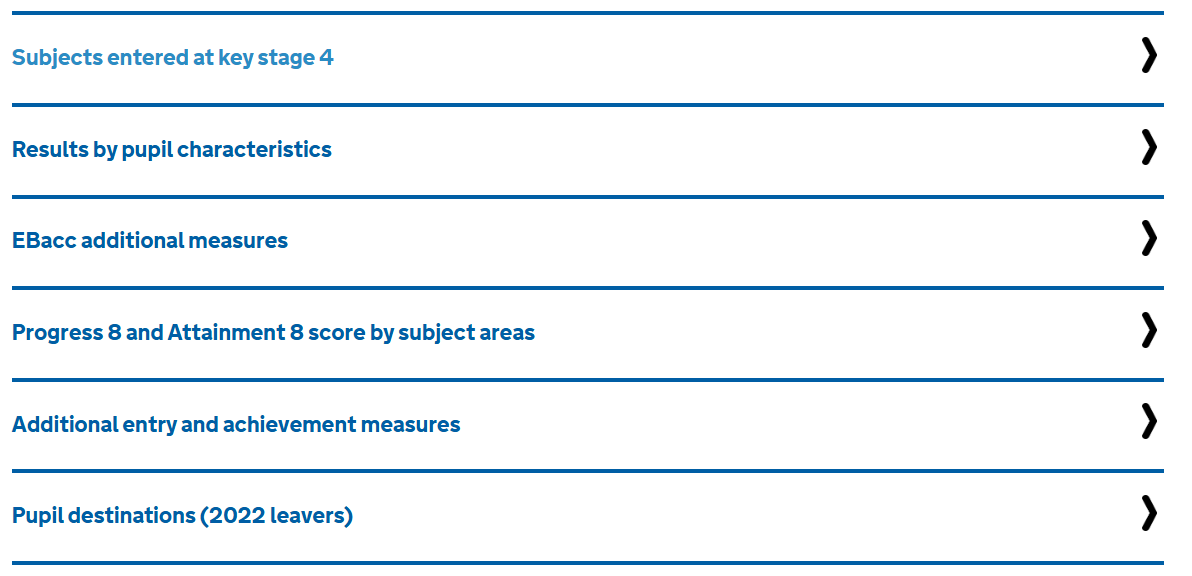
When you open the first heading, "Subjects entered at Key Stage 4" , you'll see a list similar to the one below.
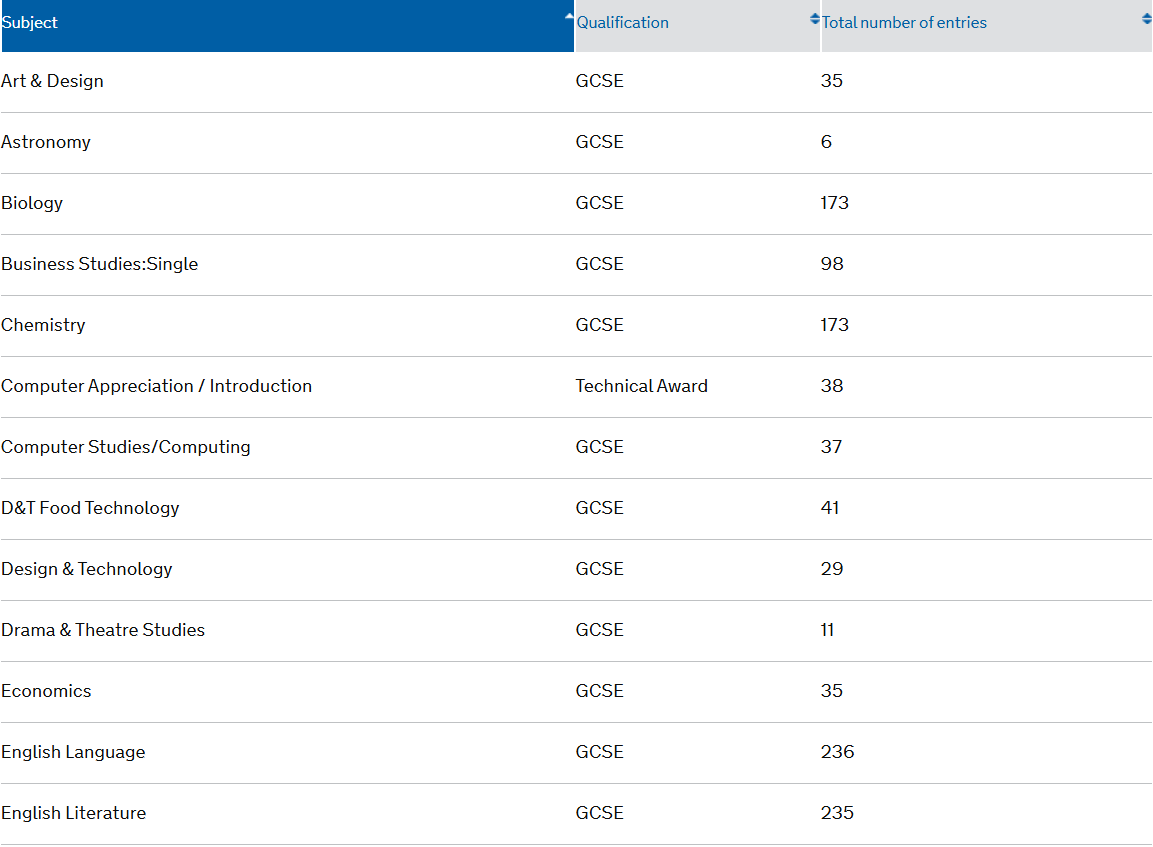

In this table, if we leave out subjects taken by only one student, such as Turkish and Portuguese , we can see that students took GCSEs in 24 different subjects. When comparing this table with other schools, as well as the number and range of subjects and whether the subjects you want are offered, you can find lots of useful information, such as what proportion of students took Triple and Double Science , how many students took Art and which foreign languages they studied.
"Results by pupil characteristics" section you can find information on the following:
- Disadvantaged pupils → pupils from disadvantaged backgrounds
- Prior attainment → how well pupils were doing before secondary school (at KS2)
- English as an additional language (EAL) → pupils whose first language isn't English
- Girls and boys → results for girls and for boys
- Non-mobile pupils → pupils who haven't changed school
You can also look at more detailed information under the other headings. But as this post is already long, and I don't think everyone needs that level of detail, I'll stop this part here.
Another report worth knowing about is the Ofsted report. I explained what Ofsted is in another blog post. If you haven't read it yet, I recommend reading it here .
You can also look at the Times and Telegraph newspapers' annual best schools lists . But remember, you may not find every school on these lists, because they only include schools that responded to the newspaper's questions.
Would you like to see where the best schools in the country are?
The page isn't finished yet, but if you're curious, you can click here to take a look.
If you've compared a few schools while deciding where your child will go, you're ready to move on to the application process. If you'd like to know more about school applications and haven't yet read my earlier blog post, now's the perfect time! You can find it here ...
To continue this guide on assessing academic results when choosing a secondary school, take a look at our post Is Academic Success Enough When Choosing a School? . If you'd like information about choosing a primary school, see this post .
That's where I'll end this post. I hope it helps with your school choice. If you have any questions about it, you can select the relevant part to ask a question or leave a comment. Please share your experiences with us!